
Two new potential strategies for returning crucial samples from Mars to Earth by the 2030s are now on the table, according to NASA.
The proposals present alternatives to the original Mars Sample Return program. Designed by NASA and the European Space Agency, the initial plan was deemed unwieldy after an independent review board projected it could cost up to $11 billion. The board’s assessment also pushed the expected return date of the samples from 2031 to 2040 — a delay that was “simply unacceptable,” NASA Administrator Bill Nelson reiterated Tuesday.
The agency will decide between the newly proposed strategies, intended to reduce complexity, cost and mission duration, by the second half of 2026, Nelson announced during a news conference on Tuesday.
The NASA Perseverance rover has been gathering rocks and dust since it landed on Mars in February 2021. Scientists believe those samples — collected from Jezero Crater, the former site of an ancient lake and river delta — might be one of the only ways to determine whether life ever existed on the red planet.
But returning the specimens to Earth, a feat that could answer one of humanity’s biggest questions about the potential for life beyond Earth, is a complex process. Both the original and new architecture for the program include multiple spacecraft that would be used to land on Mars and ferry the cache back to our planet.
In April, NASA asked its various centers and industry partners to come up with new plans for getting the samples back to Earth in a more streamlined and cost-effective way. The agency’s Mars Sample Return Strategic Review team assessed 11 of the studies and made recommendations to NASA, which were then further refined by leadership.
“We are exploring two new landing options,” said Dr. Nicky Fox, associate administrator for NASA’s Science Mission Directorate. “One is to leverage technology that was previously used to land both (the) Perseverance and Curiosity (rovers) on Mars. The other is to leverage options from industry.”
The first option will rely on the sky crane method, used for the entry descent and landing of the two rovers still exploring Mars. The second will utilize new commercial capabilities and partners to deliver a “heavy-lift vehicle” lander, such as designs from companies from SpaceX and Blue Origin, to Mars, Nelson said.
Mars has long posed a challenge to landers because its thin atmosphere is thick enough to burn up a spacecraft that isn’t tucked within an outer structure sporting a protective heat shield. But the red planet’s atmosphere is also too thin to rely on parachutes alone to slow down and create a safe landing.
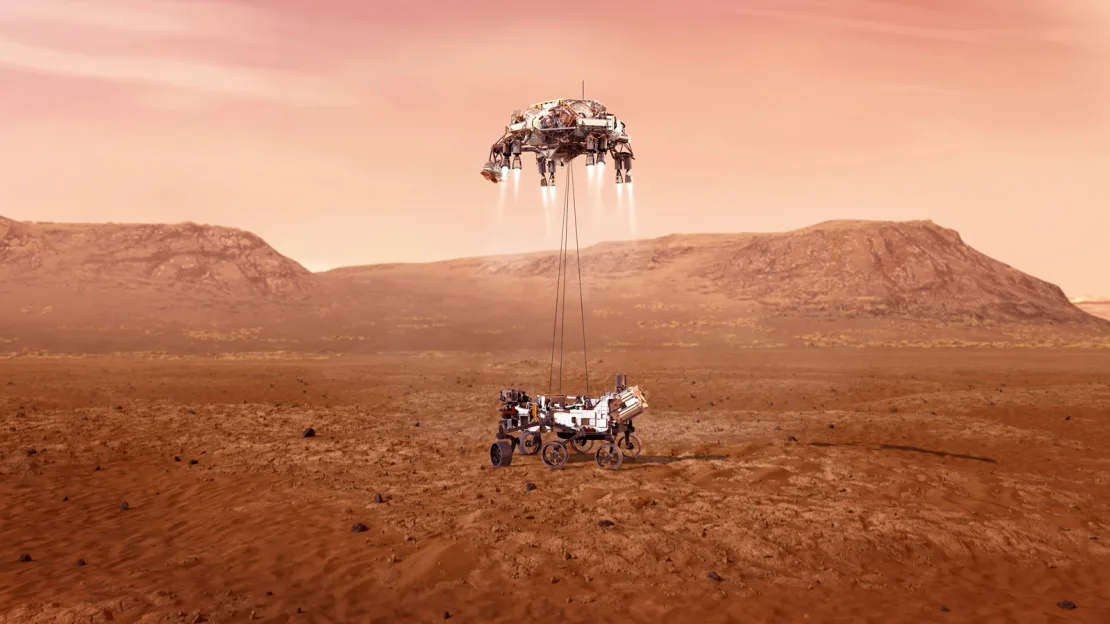
For the deployment of the hefty car-size rover Curiosity, engineers created a system called the sky crane to secure the rover during entry, descent and landing. During the initial descent, a heat shield, parachute and retrorockets slowed down the spacecraft.
Then, the sky crane lowered the rover to the surface of the red planet using a strong cable. Afterward, the sky crane disconnected and crash-landed away from the site. In 2021, the same design was used to land Perseverance, and the team was actually able to capture video of the daring descent.
An illustration depicts the Perseverance rover landing safely on Mars using the sky crane. NASA/JPL-Caltech
Journey from the Martian surface
Mars Sample Return is humanity’s first mission to bring scientific samples from a habitable planet back to Earth, Fox said.
“We want to bring those back as quickly as possible to study them in state-of-the-art facilities,” she said. “Mars Sample Return will allow scientists to understand the planet’s geological history and the evolution of climate on this barren planet where life may have existed in the past and shed light on the early solar system before life began here on Earth. This will also prepare us to safely send the first human explorers to Mars.”
The agency will proceed with testing the viability of both options and working through the engineering challenges of each plan over the next year at NASA’s Jet Propulsion Laboratory in Pasadena, California.
The newly proposed strategies provide the potential to return the samples to Earth as early as 2035, or as late as 2039, and with costs that range from $5.5 billion to $7.7 billion — a “far cry” from the original figure, Nelson said.
“Pursuing two potential paths forward will ensure that NASA is able to bring these samples back from Mars with significant cost and schedule saving compared to the previous plan,” Nelson said. “These samples have the potential to change the way we understand Mars, our universe, and — ultimately — ourselves.”

This illustration for the original concept of Mars Sample Return shows multiple robots that would team up to ferry samples to Earth from the red planet. NASA/JPL-Caltech
While both options are more streamlined than the original plan, they each contain similar architecture, which requires landing a Mars Ascent Vehicle on the Martian surface. That vehicle will be loaded with the samples collected by Perseverance, and then it will lift off, rendezvousing with the ESA’s Earth Return Orbiter in orbit around Mars.
Then, the orbiter will head back to Earth and drop off the sample capsule, similar to how rocks and dust from the asteroid Bennu were delivered by the OSIRIS-REX mission, Fox said.
There was no easy way to get rid of any single element of the original Mars Sample Return design, so the focus shifted to simplifying each piece, Fox said. For example, NASA opted for a direct return of the samples to Earth, rather than placing them in orbit around the moon, which would require another vehicle to go and fetch them, Nelson said. The biggest difference between each option will be the landing mechanism, Fox said.
For both strategies, the platform that will land on Mars will carry a smaller version of the Mars Ascent Vehicle than previously planned, and the platform’s solar panels will be replaced with a system that can supply power and heat even during dust storms on Mars. This will enable the samples to be returned to Earth sooner, Fox said.
“We are very confident that we can return all 30 samples before 2040 and for less than the $11 billion,” Fox said.
Mars sample return: The path ahead
Teams at JPL will focus on the engineering design for each plan at the same time over the next year, and one of the challenges will be making the sky crane 20% bigger than the one that landed Perseverance, Fox said. Another challenge is designing a Mars Ascent Vehicle that can survive landing on the red planet before launching from it.
The European Space Agency is currently evaluating NASA’s new plans, according to NASA.
Ultimately, President-elect Donald Trump’s incoming administration will be responsible for requesting an appropriate budget to support the program — and deciding whether they wish to continue with the program at all, Nelson added.
Nelson said he has not discussed the new Mars sample return proposals with Jared Isaacman, the tech billionaire and spaceflight trailblazer Trump has picked to helm NASA, because all discussions are being handled by the transition team, he said.
“But I think it was a responsible thing to do to not hand the new administration just one alternative if they want to have a Mars sample return, which I can’t imagine that they don’t,” Nelson said.
Previously, China has declared an interest in also returning samples from Mars. The country’s Tianwen-3 mission might launch in 2028 to retrieve the Martian samples, which could be returned to Earth by 2031, although officials previously shared that they may also launch by 2030.
“I don’t think we want the only sample return coming back on the Chinese spacecraft, and that’s just simply a grab and go kind of mission,” Nelson said. “Whereas ours has been a very methodical process … to find different samples of different layers showing different ages of material and rocks, and when we bring back those 30 samples, it’s going to give quite a history of what Mars was like millions of years ago when there was water in the lake. And the big question: Was there life millions of years ago?”