
A wheeled bot rolls across the floor. A soft-bodied robotic star bends its five legs, moving with an awkward shuffle.
Powered by conventional electricity via plug or battery, these simple robotic creations would be unremarkable, but what sets these two robots apart is that they are controlled by a living entity: a king oyster mushroom.
By growing the mushroom’s mycelium, or rootlike threads, into the robot’s hardware, a team led by Cornell University researchers has engineered two types of robots that sense and respond to the environment by harnessing electrical signals made by the fungus and its sensitivity to light.
The robots are the latest accomplishment of scientists in a field known as biohybrid robotics who seek to combine biological, living materials such as plant and animal cells or insects with synthetic components to make partly living and partly engineered entities.
Biohybrid robots have yet to venture beyond the lab, but researchers hope one day robot jellyfish may explore oceans, sperm-powered bots may be able to deliver fertility treatments and cyborg cockroaches could search for survivors in the wake of an earthquake.
A soft-bodied robot controlled by light-sensitive fungal mycelia propels itself along a surface. Anand Mishra
“Mechanisms, including computing, understanding and action as a response, are done in the biological world and in the artificial world that humans have created, and biology most of the time is better at it than our artificial systems are,” said Robert Shepherd, a senior author of a study detailing the robots published August 28 in the journal Science Robotics.
“Biohybridization is an attempt to find components in the biological world that we can harness, understand, and control to help our artificial systems work better,” added Shepherd, a professor of mechanical and aerospace engineering at Cornell University who leads the institution’s Organic Robotics Lab.
Part fungus, part machine
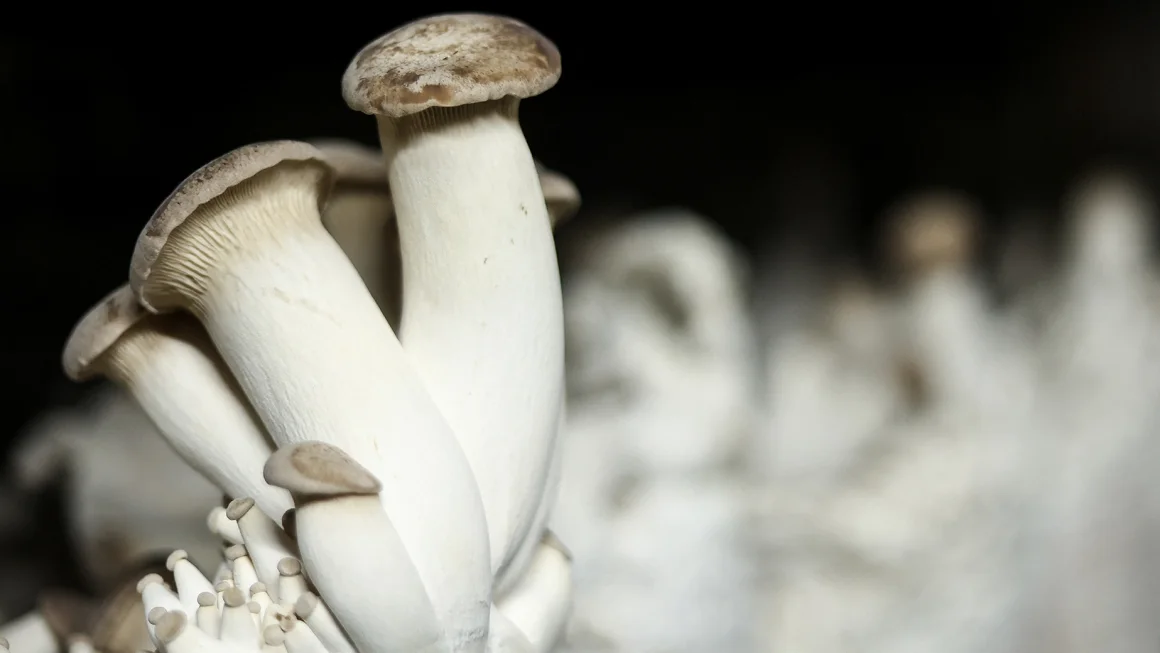
The team began by growing king oyster mushrooms (Pleurotus eryngii) in the lab from a simple kit ordered online. The researchers chose this species of mushroom because it grows easily and quickly.
They cultivated the mushroom’s threadlike structures or mycelium, which can form networks that, according to the study, can sense, communicate and transport nutrients — functioning a little like neurons in a brain. (Alas, it’s not strictly accurate to call the creations shroom bots. The mushroom is the fruit of the fungi — the robots are powered by the rootlike mycelium.)
The fungus, which was cultivated in a petri dish, required 14 to 33 days to fully integrate with the robot’s scaffolding, according to new research led by Cornell University scientists. Anand Mishra
Mycelium produces small electrical signals and can be connected to electrodes.
Andrew Adamatzky, a professor of unconventional computing at the University of the West of England in Bristol who builds fungal computers, said it isn’t clear how fungi produce electrical signals.
“No one knows for sure,” said Adamatzky, who wasn’t involved in the research but reviewed it before publication.
“Essentially, all living cells produce action-potential-like spikes, and fungi are no exception.”
The study team found it challenging to engineer a system that could detect and use the small electrical signals from the mycelia to command the robot.
“You have to make sure that your electrode touches in the right position because the mycelia are very thin. There is not a lot of biomass there,” said lead author Anand Mishra, a postdoctoral research associate in Cornell’s Organic Robotics Lab. “Then you culture them, and when the mycelia start growing, they wrap around the electrode.”
Mishra engineered an electrical interface that accurately reads the mycelia’s raw electrical activity, then processes and converts it into digital information that can activate the robot’s actuators or moving parts.
The robots were able to walk and roll as a response to the electrical spikes generated by the mycelia, and when Mishra and his colleagues stimulated the robots with ultraviolet light, they changed their gait and trajectory, showing that they were able to respond to their environment.
“Mushrooms don’t really like light,” Shepherd said. “Based on the difference in the intensities (of the light) you can get different functions of the robot. It will move faster or move away from the light.”
A wheeled robot controlled by fungal mycelia responds to light and rolls across a surface. Anand Mishra
‘Exciting’ work
It’s exciting to see more work in biohybrid robotics that moves beyond human, animal and insect tissues, said Victoria Webster-Wood, an associate professor at Carnegie Mellon University’s Biohybrid and Organic Robotics Group in Pittsburgh.
“Fungi may have advantages over other biohybrid approaches in terms of the conditions required to keep them alive,” said Webster-Wood, who wasn’t involved in the research.
“If they are more robust to environmental conditions this could make them an excellent candidate for biohybrid robots for applications in agriculture and marine monitoring or exploration.”
The study noted that fungi can be cultivated in large quantities and can thrive in many different environments.
The researchers operated the rolling robot without a tether connecting it to the electrical hardware — a feat that Webster-Wood called particularly noteworthy.
“Truly tetherfree biohybrid robots are a challenge in the field,” she said via email, “and seeing them achieve this with the mycelium system is quite exciting.”
Biohybrid robotics in the real world
Fungi-controlled technology could have applications in agriculture, Shepherd said.
“In this case we used light as the input, but in the future it will be chemical. The potential for future robots could be to sense soil chemistry in row crops and decide when to add more fertilizer, for example, perhaps mitigating downstream effects of agriculture like harmful algal blooms,” he told the Cornell Chronicle.
Fungi-controlled robots, and fungal computing more broadly, have huge potential, according to Adamatzky.
He said his lab has produced more than 30 sensing and computing devices using live fungi, including growing a self-healing skin for robots that can react to light and touch.
Andrew Adamatzky, a professor of unconventional computing at the University of the West of England, helped grow from fungus a self-healing skin for robots that can react to light and touch that was described in a separate January study. Antoni Gandia
“When an adequate drivetrain (transmission system) is provided, the robot can, for example, monitor the health of ecological systems. The fungal controller would react to changes, such as air pollution, and guide the robot accordingly,” Adamatzky said via email.
“The emergence of yet another fungal device — a robotic controller — excitingly demonstrates the remarkable potential of fungi.”
Rafael Mestre, a lecturer at the School of Electronics and Computer Science at the University of Southampton in the United Kingdom who works on the social, ethical and policy implications of emergent technologies, said that if biohybrid robots become more sophisticated and are deployed in the ocean or another ecosystem it could disrupt the habitat, challenging the traditional distinction between life and machine.
“You are putting these things into the trophic chain of an ecosystem in a place where it shouldn’t be,” said Mestre, who was not involved in the new study. “If you release in big numbers it could be disruptive. I don’t see at this moment this particular research has strong ethical concerns … but if it continues to develop I think it’s quite crucial to consider what happens when we release this in the open.”