South Korea is reeling after a whiplash six hours during which the country’s embattled president declared martial law but was forced to lift it amid widespread condemnation, throwing the country’s political landscape into chaos and uncertainty.
The saga began unfolding Tuesday night as most South Koreans prepared to go to sleep – prompting furious lawmakers to force their way past soldiers into parliament to strike down the decree, as protesters demanded President Yoon Suk Yeol’s removal and no return to the country’s painful authoritarian past.
By dawn, the president had caved – agreeing to lift martial law. But experts say he’s dug a political grave; opposition parties are already moving to introduce impeachment measures.
Questions are still swirling around the future of Yoon’s presidency, his party’s rule, and what happens next in one of the world’s most important economies and a major United States ally.
Here’s what we know.
What happened? What is martial law?
Yoon declared martial law around 10:30 p.m. local time Tuesday in an unannounced late-night TV address, accusing the country’s main opposition party of sympathizing with North Korea and of “anti-state” activities.
He also cited a motion by the opposition Democratic Party, which has a majority in parliament, to impeach top prosecutors and reject a government budget proposal.
Martial law refers to granting the military temporary rule during an emergency, which the president has the constitutional ability to declare. But the announcement hit like a bombshell, sending shock waves through a democratic nation and sparking an astonishing late-night political showdown.
In a nation with a strong contemporary tradition of free speech, Yoon’s military decree banned all political activities, including protests, rallies, and actions by political parties, according to Yonhap news agency. It also prohibited “denying free democracy or attempting a subversion,” and “manipulating public opinion.”
In the end, the decree only lasted a few hours.
Lawmakers flocked to the parliament, pushing their way past soldiers who had been deployed to keep the building blocked off.
In an extraordinary emergency late-night meeting, those present voted unanimously to block the decree, a vote the president is legally bound to obey.
The country’s political blocs came together to oppose Yoon’s decree – including members of his own party, with the party chief apologizing to the public and demanding an explanation from the president.
By 4:30 a.m., Yoon announced he would comply and lift the martial law order, saying he had withdrawn the troops deployed earlier in the night. But he doubled down on accusations that the opposition party was frustrating the moves of his government, urging lawmakers to stop their “legislative manipulation.”
Yoon’s cabinet voted to lift the decree soon after.
Political paralysis
South Korea has been in a bitter political stalemate for months, with the country’s liberal opposition parties winning a parliamentary majority in April. The election was widely seen as a referendum on Yoon, whose popularity has plummeted due to a number of scandals and controversies since he took office in 2022.
Yoon, a conservative, has clashed with the opposition on many of his policies that require legislation, preventing him from moving forward on campaign promises to cut taxes and ease business regulations.
He has also grown increasingly frustrated with the opposition’s efforts to impeach government figures, some of whom he’d appointed – including the chair of the broadcasting watchdog, the chair of the state auditor, and several top prosecutors, according to Yonhap.
The prosecutors in particular are a sore point for Yoon. Opposition lawmakers argue they failed to indict Yoon’s wife, the first lady – who has been embroiled in scandal and accusations of stock manipulation, which the presidential office has repeatedly denied.
What was the response?
Outrage, shock and confusion ran through the country – and the world – in the immediate aftermath of the decree.
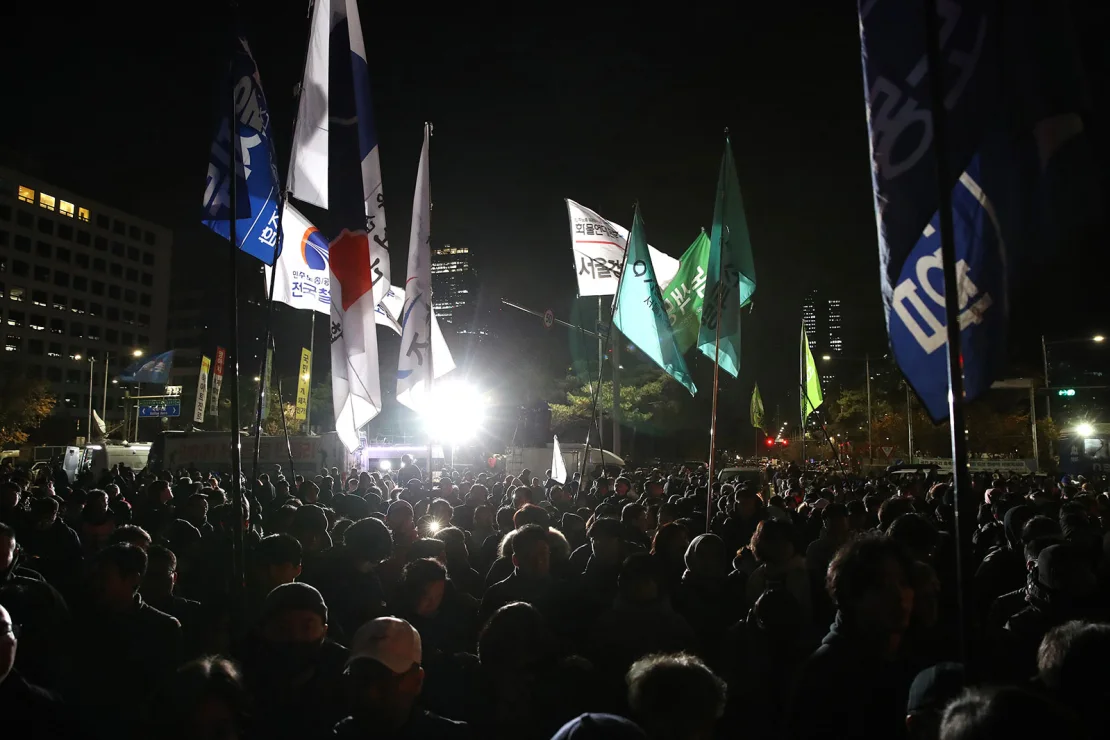
Late Tuesday night, residents in the capital Seoul rushed to be with their family members, while others gathered in front of the parliament building, where law enforcement told some they could be arrested without warrants.
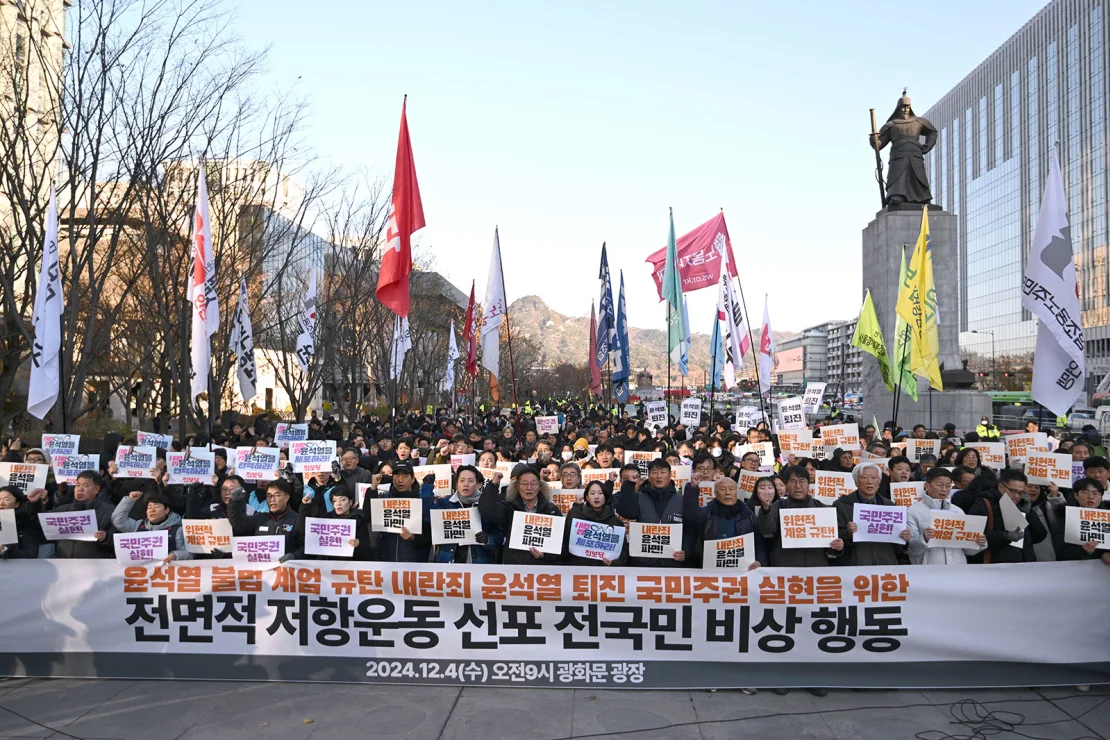
Many protesters carried signs and flags calling for Yoon’s impeachment.
Some members of parliament appeared to clash with authorities outside the parliament building, with television footage showing troops attempting to enter the main hall – though they began withdrawing a few hours later when lawmakers blocked the decree.
What does it mean for the US?
The US voiced “grave concern” after Yoon declared martial law, and expressed relief after he lifted the decree – saying democracy was at the core of the US-South Korea alliance.
The two countries have a decades-old mutual defense treaty, which means both must come to the aid of the other if they are ever attacked.
There are nearly 30,000 American troops stationed in South Korea, across key US military installations – including Camp Humphreys, the largest US military base overseas.
Alongside Japan and the Philippines, which also have mutual defense treaties with the US, South Korea is part of a trio of regional partners that have helped to bolster American power in both Asia and the Pacific for decades.
Advocates argue that a significant US troop presence in the Korean Peninsula is crucial to deterring any potential attack from North Korea as Kim Jong Un’s regime continues to build its nuclear arsenal, and as a way of bolstering the US presence in the region to counter China’s aggression.
North Korea has also become a key player in Russia’s invasion of Ukraine by sending troops to help fight for Moscow’s forces, bringing an isolated Asian power into Europe’s largest conflict since the Second World War.
What happens now?
Much remains uncertain – including what will happen to the president and other top leaders.
Six opposition parties submitted a bill to the legislature on Wednesday calling for Yoon’s impeachment, Yonhap reported. The bill is expected to be reported to a plenary session on Thursday, with voting set for Friday or Saturday.
Earlier Wednesday, the main opposition party – one of the six behind the bill – warned it would start impeachment proceedings if Yoon didn’t step down immediately, and said it planned to file treason charges against him.
If approved by at least two thirds of parliament, the impeachment motion would go to the Constitutional Court – one of the country’s highest courts – where at least six justices have to agree to go ahead with the impeachment. During this time, the president would be suspended from exercising his power.
Yoon’s chief of staff and more than 10 senior secretaries to the president have submitted their resignations, according to the president’s office.
The president accepted the resignation of his Defense Minister Kim Yong-hyun and nominated South Korea’s ambassador to Saudi Arabia Choi Byung-hyuk to replace him, the defense ministry said on Thursday morning local time.
This isn’t the first time Yoon has faced calls for impeachment – with regular protests calling for his resignation, and a petition that received hundreds of thousands of signatures, Reuters reported.
South Korea’s largest umbrella union also said on Wednesday its members would go on an indefinite general strike until Yoon resigns.
Is this unusual for South Korea?
Yes – especially given the country’s long, painful crawl toward democracy after decades of authoritarian rule.
South Korea has been a vibrant democracy since the 1980s, with regular protests, free speech, fair elections and peaceful transfers of power. The domestic political scene has long been fractious, with presidents on both sides of the political divide often facing prosecutions while in and out of office.
Martial law is unheard of in the modern democratic era, which has seen South Korea become a major exporter and a cultural powerhouse, thanks in part to the huge global popularity of K-pop and K-drama.
But South Korea has a dark political past. Throughout much of the Cold War, the country went through a series of strongman leaders and military rulers, who declared martial law multiple times – sometimes in a bid to hold onto power amid growing public dissatisfaction.
At the time, protests could easily turn deadly, with the military deployed to crack down on those pushing back.
The last time a South Korean president declared martial law was in 1980, during a nationwide uprising led by students and labor unions. It wasn’t until 1988 that South Korea elected a president through free and direct elections.
That’s why protesters Tuesday and Wednesday held signs and chanted slogans vowing to never go back to dictatorial rule, the memory of which remains fresh in many people’s minds.
Correction: This article has been updated to finesse the length of the overnight political brinkmanship.