
November 27, 2024
1
In 2008, Salman Khan—formerly a hedge fund analyst in Boston who tutored his cousins on the side—launched Khan Academy, a free online educational platform that quickly became a repository of thousands of video lessons for students, covering everything from AP Chemistry to middle school math.
Almost immediately, Khan told me in a recent interview, the platform was perceived as an existential threat. “In the very early days of Khan Academy, people would see these videos and exercises we were creating and think ‘Well, does this replace a teacher?’”
Khan’s latest project, dubbed Khanmigo and launched in 2023, provokes some of the same fears. Pairing generative AI with a user-friendly interface, the application, which is being piloted by over 600,000 students and teachers in the U.S., promises to deliver a personalized tutor to every classroom, allowing students to plug in and receive instruction on subjects ranging from elementary math to essay writing. Instead of simply providing answers to their questions, Khan says, new AI bots like Khanmigo are trained to serve as “thoughtful” mentors, prodding students with questions, giving them encouragement, and delivering feedback on their mistakes as they work to develop their own understanding.
The technology has had some public missteps. Earlier this year, a report in The Wall Street Journal found that Khanmigo, like other large language model AI tools, struggles with basic math, frequently making errors of logic or computation and struggling to accurately correct user mistakes.
Despite these stumbles, Khan remains bullish on AI’s prospects.

In his recent book, Brave New Words: How AI Will Revolutionize Education (and Why That’s a Good Thing), he doubles down on his mission to scale “world-class personalized learning.” AI can serve as a super tutor of sorts to kids, he says, but also help human teachers with time-intensive tasks like lesson planning and assessment writing, and free up valuable “time for personalized learning, hands-on activities, or classroom conversation”—the sort of assistance that, rather than replacing teachers, can make them “more valuable, not less.”
I spoke to Khan about why he’s so excited about the potential of AI tutoring, how he believes it will reshape classrooms of the future, and why he thinks certain human elements of teaching will always outlast technological advancements.
ANDREW BORYGA: Why do you think one-on-one tutoring is so valuable for students?
SALMAN KHAN: For most of human history, if you asked someone what great education looks like, they would say it looks like a student with their tutor. Alexander the Great had Aristotle as his tutor. Aristotle had Plato. Plato had Socrates.
Intuitively it makes sense. When you have that one-on-one instruction, or small-group instruction, the instruction caters to your needs. If a student is finding something easy, then a tutor can move ahead or go deeper. If they’re struggling, a tutor can slow down. The human element of tutoring is important, too: knowing there’s another human being who sees you, listens to you, and is willing to spend time to help you.
Anyone who is serious about learning something well does it this way—serious musicians or athletes, for example. The only reason we don’t do it at scale in schools is because it’s not economically viable. Substantial one-on-one time with a teacher tends to get lost when you have 30-plus students in a classroom. At that point, teachers often only have the bandwidth to focus on the kids at the extremes—the kids who are either really struggling academically or behaviorally, or the handful of kids who are stars.
Start of newsletter promotion.

A Friendly Reminder!
If you’ve already created an account, make sure you’re signed in to see stories matching your interests.
End of newsletter promotion.
BORYGA: And you think generative AI can provide personalized tutoring at scale?
KHAN: I’m excited about this latest generation of AI because it is inherently conversational. It can not just pretend to take on personas, but really embody those personas.
I got started tutoring my cousins remotely, as a side hobby, 20 years ago. If you look at what generative AI can do, it is pretty much indistinguishable from what I used to do while chatting remotely with my cousins.
But it can do so much more, too. Over the last 15 years, for example, one of the main critiques of Khan Academy—which I don’t disagree with—is that while it’s great to have on-demand videos that approximate certain aspects of tutoring, what do you do if you have a question? What if you need some more motivation, or you want to connect what you’re doing in a given exercise to the real world? AI can help with these things, and will continue to get better.
One of the things we’re looking at improving is making our AI more proactive. A good tutor doesn’t just wait to be asked a question. A good tutor pushes a student. I used to say that one of the benefits of AI is that it’s infinitely patient. But we’ve realized that maybe it shouldn’t be infinitely patient—maybe it should hold the student to account. I think we’ll get there, and, in the next five or 10 years, we’ll have AI bots capable of truly working in conjunction with human teachers, while offering on-demand support to students in ways that are almost identical to how I supported my cousins.
If you were to visit a classroom that’s using AI in this way, it wouldn’t look like you’re in the future—until you really paid attention to what the teacher is spending time on.
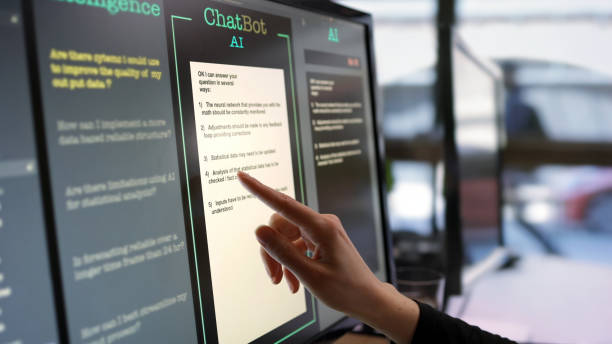
A woman’s hand is asking an AI chatbot pre-typed questions & the Artificial Intelligence website is answering.
Sal khan
BORYGA: Speaking of the future, what do you think learning will look like if AI tools like Khanmigo are utilized to their fullest potential? What could a typical classroom look like in the next 5 to 10 years?
KHAN: We are building toward a world, I think, where a teacher or a school district can upload curriculum, academic standards, and the school year calendar—and then the AI can work with a teacher to plan the entire year with a calendar that includes not just scope and sequence, but pacing. It will take each of those nodes—those days, or weeks—and plan out the lessons, too.
But not cookie-cutter lessons. AI lessons might anchor off of the standards or the curriculum, but they will also say, “Hey the kids zoomed through this one topic, so we can spend a little more time on this one.” Or, “This is a great moment to switch to a game because the kids seem like they’re lacking in motivation.” It’s not just planning, but administering lessons and being responsive.
Teachers, meanwhile, can use the AI to create presentations, quizzes, surveys, exit tickets—the activities kids are going to interface with in class. And if a student finishes their activity early and does a good job, the AI can let them go deeper—which is something that is historically hard for a teacher to do in a big, diverse classroom—or even allow them to continue working on prerequisites they’re struggling with.
If you were to visit a classroom that’s using AI in this way, it wouldn’t look like you’re in the future—until you really paid attention to what the teacher is spending time on. More teachers would be able to do what excellent teachers do: create really engaging activities that facilitate active learning customized to the interests of their students. I think you’re going to see fewer kids who are disengaged because the AI will focus them on the teacher’s task, and be able to adjust things if they’re lost or bored.
BORYGA: In your book you say that back in 2022 ChatGPT was “getting math incorrect more than I liked,” which is something AI bots have received plenty of criticism for. How has AI improved at math since then?
KHAN: There are different dimensions to the problem. One is: Can AI do the math? Can it solve a problem correctly? In that dimension there’s been dramatic improvements from the base models. If you give the same question to the earliest ChatGPT models and the newest models, the new models are much better at math—especially the type of math that you would encounter in K–12 classrooms.
A slightly harder thing is getting the math tutoring right. There’s a lot of subtlety in how you evaluate a student response as a tutor. For example, let’s say the answer to a question is one-third and the student says 0.33. Are they right? If I’m the tutor I might say, “Are you sure it’s exactly .33?” And the student will likely correct themselves. That’s an area where the models have not traditionally been that great. But we’ve been working a lot on it over the past year.
Part of that includes measuring the error rates. We were previously in the 6 to 7 percent error rate territory—especially for tutoring in advanced math. Now we’re at about 3 percent. Obviously I would like to get that down to 0.03 percent, but I spend a lot of time working with my own children, and I’d actually be surprised if my own error rate is that good.
BORYGA: Khanmigo is currently being piloted by more than half a million K–12 students and teachers in the U.S. What big insights are you gleaning from these pilots?
KHAN: What we’re seeing on the student side is there is a category of student who just immediately knows how to use Khanmigo and gets a lot of value and deep understanding out of it. But we also see a majority of students don’t just naturally know how to articulate what they need, which was a bit of a surprise because we created a very natural, easy-to-use interface. When we talk to teachers about this issue, what they say is that a lot of students have trouble articulating to the teacher what they need help with. That’s why we want our AI to be more proactive.
Imagine you’re in a classroom and you have an amazing PhD student who says, “I’m in the back of the classroom, anyone who needs me, come ask me a question.” I would guess that about 15 percent of kids would take them up on that, and 85 percent won’t know what question they need answering, or won’t be engaged enough to have one. Our coaching to that tutor would be: “You have to proactively talk to those students—and especially those students who aren’t reaching out to you, the ones that aren’t making eye contact with you.” Those are the ones that the PhD student should sit down with.
That’s what we’re working on with Khanmigo, too.
BORYGA: Many teachers argue that AI undermines the development of foundational human skills—writing, reading, critical thinking. What do you think about that, as you look toward the future? Will AI make us smarter, or dumber?
KHAN: If you think about the internet, is it making us smarter or dumber? I think the answer is probably both. I say this in every speech I give: Technology amplifies human intent. The technology itself is neutral. There will always be bad actors and people who have bad intentions, so in order for technology to be a net positive, you need to have good people working on things with a good intention for self-improvement, learning, and motivation.
For example, when generative AI first became widespread, people immediately jumped to a conclusion: “This will be used for cheating on essays.”
And it can be. But we are working on solutions.
We just launched Writing Coach, where the teacher creates an assignment with the AI and the AI works on it with the student. It’s very structured: The student and the AI brainstorm together, outline, and draft together. The student author can move around different parts of the writing, and throughout the process, the AI can highlight specific parts and provide feedback.
On the other end, when the student submits their paper, the teacher gets not only the final output, but the process as well—and they can talk to the AI about that process. And if the student goes and copies and pastes from ChatGPT or drops in something their older sister wrote for them, the AI will notify the teacher: “Hey, there’s this chunk of text that was just pasted in that we never talked about. Look into it.”
That’s an example of a tool that not only undermines AI cheating but also supports individual students in ways that they haven’t always been supported before. The teacher will always be in charge. But if they can go from spending 10 or 20 hours grading 100 papers on The Great Gatsby and cut it down to an hour, then their students will get feedback faster and the teacher will be able to assign more writing practice, too.
Cre: Andrew Boryga