
Soon after I was hired as assistant professor of Latinx studies, my department, Romance Languages and Literatures, was presented with what in the university we refer to as a “line,” the opportunity to hire a full-time tenured or tenure-track professor.
Tenure is an unusual system, unique to academia, that guarantees lifetime employment for faculty. It was designed to protect academic freedom and the intellectual work of faculty from external pressures, allowing for necessary but often controversial work to be done without fear of losing employment. In principle, tenure is supposed to protect professors who may criticize the government, shed light onto corrupt systems, or write about things that upset the structures of power. In reality, tenure functions as a reward, a sign of prestige vested upon the few faculty who are able to publish with prestigious presses, secure grants, and make an impact in their respective fields. Sadly, controversial scholars who rock the boat are, more often than not, denied tenure. Tenure lines are coveted in academic departments, particularly in the humanities, for they potentially attract prestigious, well-established scholars who can build up the reputation of the department, support ongoing research agendas, advise students, and serve in the various administrative roles within the unit. Lines include tenured associate (midcareer level) and full professors (who have already found the holy grail), as well as assistant professors (usually newly minted Ph.D.’s who are working toward tenure).

In the eyes of the administration, there could be only one of us.
Over the last two decades, tenure lines have become scant. According to the American Association of University Professors, only about 21 percent of faculty are tenured. The scarcity of tenure lines often causes rivalry between departments competing to obtain them. Following the neoliberal trend that affects all industries across the globe, the modern university is more concerned with cost reduction and the amassing of its endowment than with the production of knowledge and the well-being of its students. To maintain its neoliberal model, the university has significantly reduced its investment in full-time tenured professors, who cost more money and teach fewer courses as they are required or expected to conduct research and publish. Instead, universities employ low-paid graduate students and temporary, part-time teaching staff, such as adjunct professors and instructors, to teach the majority of the undergraduate courses. Even though adjuncts—like tenure-track and tenured professors—have doctoral degrees, they are paid less. Oftentimes, adjuncts are paid a flat rate per course rather than a salary or a per-hour rate. These flat rates amount to outrageously low wages, below the federal minimum, and put adjuncts’ pay below the poverty line. Adjuncts are not offered health care benefits, research support, or at times, even an office space. In the humanities and social sciences, temporary, contingent, or part-time employment is most common.
In this dire employment climate in which humanities units, such as Romance Languages, English, and Comparative Literatures, have been hemorrhaging student enrollment for decades all across the United States, hearing that our Romance Languages and Literatures department had received the approval of a tenured line was beyond exciting. During the faculty meeting, the chair asked all tenured and tenure-track faculty to offer our input to determine the specialization we should search for in the new hire. Romance language departments are tricky, as they merge language learning and the literary and cultural studies of the Spanish-, French-, Italian-, and Portuguese-speaking worlds. The dynamics at play between, for example, scholars of France and specialists in Francophone Caribbean studies often mimic the very. problematic colonial and racial tendencies that have shaped the unequal relationship between the European and U.S. empires and the colonized sites. Think, for example, about the media portrayal of Haiti. The news cycle following the 2010 earthquake or, more recently, after the murder of Haitian president Jovenel Moïse in 2021, consistently referred to Haiti as the so-called “poorest country in the Western Hemisphere.” By contrast, France is more often than not portrayed as a site of civility and culture, a country of beautiful, romantic cities, amazing wine, and great literature. The colonial structures that produce France as a site of civilization and Haiti as a hopeless location of underdevelopment are also at play in academic departments in ways that shape who is hired, what courses are taught, and which scholars are more valued, regardless of where students’ interests lie.
Logic and students’ needs are not exactly how departmental decisions are made.
The biggest and most ridiculous irony of Romance language departments is that those who do the most—usually professors who teach the literature of colonized countries—to serve the largest number of students also have the lowest salaries, are less likely to be tenured, and experience daily microaggressions from colleagues, administrators, and students. They are also more likely to be professors of color.
Over the past two decades, departments of Romance languages and literatures have been attracting Latinx students who, due to language and cultural affinity to Spanish and Portuguese, gravitate toward courses that focus on contemporary topics such as literatures of migration and postcolonial studies. At Harvard, where I worked for eight years in the Department of Romance Languages and Literatures, courses on Latin American and Latinx studies often sustained an enrollment of 50-plus students per semester, while a course focusing on, let’s say, the Italian Renaissance would have an enrollment of six students. At the University of Georgia where I also worked in the Romance Languages Department, our largest course was an introduction to Latinx literature—the course consistently enrolled 125 students per semester. Given this trend, and being the only Latinx studies scholar in the school’s entire faculty of arts and sciences and one of only two Latinas teaching in the humanities at the time, when asked whom we should hire for the line, I raised both hands and insisted we prioritize hiring a Latinx studies scholar. I suggested, too, that we make an effort to attract women candidates of color. Spoiler alert: The department instead chose to hire another expert in European literature, a white man.
Harvard, like many other elite schools throughout the United States, has significantly increased its admissions of students of color. By the beginning of fall 2021, 54 percent of undergraduate students identified as nonwhite; yet the number of faculty of color is still dismal. As a result, the few of us POC working in the university found ourselves overwhelmed by requests from students, administrators, and colleagues scrambling to serve the growing student of color population. Amid such inequality, it was logical to me that when presented with the opportunity to hire a full-time professor, we should prioritize the needs of the underserved student population. But, as I soon realized, logic and students’ needs are not exactly how departmental decisions are made. At the end of the meeting, a well-intentioned white senior colleague pulled me aside and told me that to protect my tenure, the department should not be hiring anyone else in Latinx studies, and especially not another Latina. They were sincere and well-meaning in their desire to protect me; they knew that in the eyes of the administration, there could be only one of us.
The experiences of unbelonging that shape life in the university for students and faculty of color—particularly those of us who come from working families and who are the first in our families to obtain college degrees—are sustained by white supremacy, by the belief that we, as minoritized people of color, do not belong; that we are only allowed to be part of these institutions because of our race and gender rather than despite it; that we are the “diversity hires.” This belief shapes every aspect of our work as women of color: it disturbs our physical movements through spaces, while it also burdens us with responsibility for institutional labor regarding issues of race, diversity, and inclusion. That is, we are asked to lead the task forces on “diversity issues,” speak to our boards about “equity and inclusion,” and serve as mentors, leaders, liaisons for any and all conversations, plans, and institutional efforts to save face regarding racial inequality. We are then Band-Aids they hope to put on their hemorrhaging racial wounds.

Sara Ahmed has written extensively about the university and academia in the United Kingdom and Australia. She describes what she calls the “stranger experience” in those institutions: what some of us who cannot pass as white go through when we become noticeable to our institutions precisely because our bodies are assumed to not belong in the whiteness of that space.5 For me, a light-skinned Black Latina from a working-class background, an immigrant with a Latinx accent, and a graduate of a public university in New Jersey, my strangeness has marked me as lacking what my colleagues often refer to as the “pedigree” required to succeed in the elite university (whiteness, wealth, an Ivy League education, a recognizable last name, maleness, and the support of powerful mentors).6 In their introduction to Presumed Incompetent II: Race, Class, Power, and Resistance of Women in Academia, Yolanda Flores Niemann, Gabriella Gutiérrez y Muhs, and Carmen G. González argue that when it comes to diversity and belonging, the university is “the last bastion of elitism and sanctioned racism in the United States.”7 It is a hostile environment “grounded on racism, sexism, homophobia, and classism” where violence—which takes many forms, as the examples I have shared thus far illustrate—against faculty and students of color is naturalized.
We are then Band-Aids they hope to put on their hemorrhaging racial wounds.
My unbelonging to the university shaped my relationship to colleagues, the administration, and the institution to one of tacit, yet mutual, discomfort. That is, my daily encounters with white colleagues at department meetings and other institutional spaces highlighted how whiteness—being or “acting” white, speaking through whiteness, and performing white civility—was clearly a prerequisite to succeeding as a woman of color scholar in the university. This manifested in subtleties like the colors, brands, and style of our clothes and accessories; our hairdos; and the speech tone, diction, mannerisms, and affect used while speaking in public. I remember, for example, one day at the beginning of a faculty meeting, I bumped into a friend who teaches at a different department and whom I had not seen in almost a year. We hugged and verbally expressed our happiness to see each other. A white male professor looked at us in surprise before stating, “I believe this room has never seen such expressions and effusiveness.” He was clearly made uncomfortable by our expressions of affection. I am by nature a warm person. I express care to people. The comment took me by surprise, as it made me realize how much of who I am and how I move in the world are unacceptable within these spaces of whiteness. My failure to perform, understand, speak, and be in harmony with whiteness made me, in Ahmed’s term, a “stranger” to the institution: an irreconcilable body that both carried and spread discomfort. As Ahmed writes, “A stranger experience can be an experience of becoming noticeable, of not passing through or passing by, of being stopped or being held up.” My strangeness fueled my unbelonging.
While “strangers” like myself are sometimes invited to be part of the elite university through neoliberal practices of diversity and inclusion, ultimately, to preserve the harmony of the institution, we are also asked to assimilate via silence or erasure. Over the years, I have been advised by colleagues to “smile more,” “be careful not to let people know you’re a single parent,” “make sure you don’t speak Caribbean Spanish with your colleagues,” and perhaps “lose a little weight.” We are expected to make white people comfortable with our presence, or we risk being expunged. My unwillingness or inability to be in harmony with whiteness—to mute my strangeness in the institution and accept its implicit white supremacy in all aspects of institutional, curricular, and academic life—culminated in my dismissal from Harvard via tenure denial in 2019.

Being expunged by whiteness via tenure denial was one of the most violent and difficult yet edifying experiences of my career. As a survivor of emotional and sexual violence, I know all too well how draining and complex the process by which we come to terms with the effects of violence is on our bodies and psyche. How long it takes before we finally see that the harm done is not our fault. The guilt and shame we feel is weaponized by our abusers. It takes distance, time, work, and support to really see ourselves as survivors and to appreciate the courage that it takes to survive.
So, how do we remember to care for each other together in colonizing, white supremacist, elitist, patriarchal spaces like the university? How do we hold ourselves and others in the face of an individualistic racial capital regime that insists we remain isolated from one another—that we “eliminate the competition” and become The One in order to succeed through the logic of exceptionalism? First, we need to recognize and understand that our legacy, who we are and how we have come to occupy the space we do in the institutions we work for/in—and on this earth—has been the result of collective rebellion. Second, we must collectively force the university (or whatever institution we work in) to see the violence they perpetuate on our persons, our bodies, our psyches, and our work. Third, we must insist—by any means necessary—on recognition for the totality of our labor: the hours spent supporting the students of color the university ignores, the months of service on committees, the emotional and mental labor required of us to exist as The One, the love and care that we put into our teaching, advising, and mentoring, and the significance of our public facing work. That “invisible” labor needs to become visible, evaluated, rewarded, valued, and compensated. That “other” labor should also become required of all faculty, not just of some of us.

Finally, we must rebel—collectively, loudly, tirelessly—against the toxic logic of The One that threatens our careers and our lives. Rebelling is a communal process. It requires all of us to recognize that academia is killing women of color and we must therefore fight back. But most importantly, we must rebel by creating communities of freedom within and outside the institution. In these communities we can hold each other, give each other the benefit of the doubt, hold for each other a space of compassion. We can offer a hand to pull us through, a back to help us cross, and a shoulder where we can safely rest our heads for a brief moment until we can lift them up again and keep on. Community is the most effective form of rebellion.
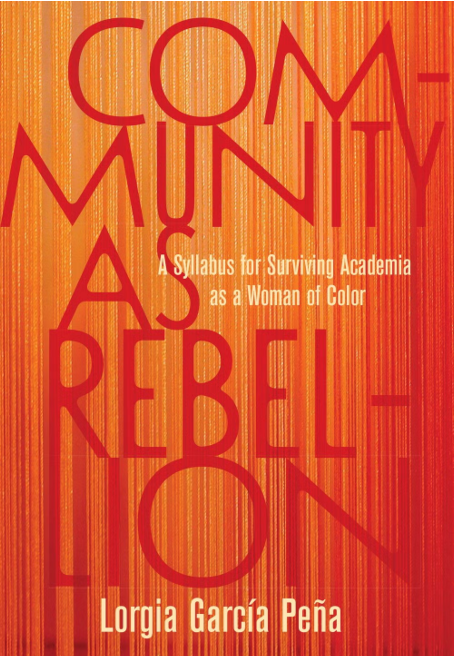
This is an excerpt from Community as Rebellion: A Syllabus for Surviving Academia as a Woman of Color (Haymarket Books, 2022).
Cre: Harper’s Bazaar